The Lauras was released on time, and if there were any negative reviews then I haven't seen them - and it would probably be good if it stayed that way, as I was a basket case for the week leading up and the week after publication. And now I'm a bit of a basket case again, because on Thursday I'll be at Edinburgh Book Festival, reading from and talking about book the second for the first time, and dammit if I don't have the slightest clue what questions, from audience or chair, the whole thing will lead to. In honesty, the only reason that I'm not hiding under the bed is that I've been paired with Jenni Fagan with The Sunlight Pilgrims, and there's a good chance I'll spend too much time asking her questions about her books to answer any about my own.
Dave gets to come along this time; I'm far too excited about getting to show him the yurt.
Showing posts with label Incoherent rambling because overworked. Show all posts
Showing posts with label Incoherent rambling because overworked. Show all posts
Tuesday, 23 August 2016

Monday, 4 July 2016
Thesis mode
My memory is odd. Looking back I get the impression that I've spent the last six months in general idleness, avoiding work and skiving off, and present Sara hates past Sara because of it, because when the looking back occurs present Sara is usually hustling to meet a deadline and wondering why past Sara didn't take care of it. But when I flip back through my diary it becomes clear why past Sara didn't take care of it, because past Sara generally does far more hustling of other types than present Sara remembers.
Today was the day that the first rough draft of my critical thesis was due to my supervisor. A week ago today was the day that I actually began working on it, because in the month before that I owed Henry 20,000 words, taught for FLY, presented at a conference, spent a week in the US doing research, judged a short fiction prize, had Annual Progress Review, and more or less kept up with the planning of my own conference. So the acrimony directed at past Sara was generally groundless, as very little skiving took place.
I've been writing up my research periodically as I've gone along, more as notes on what I've done than as actual readable material, and I've churned out a handful of self-contained pieces, so writing the first draft was less 'writing' than 'figuring out what part of what I already had was useable.' And if I'm bad at remembering what I've done, I'm even worse at remembering what I've already included in a document. So instead of approaching the thesis with any dignity, I took the arts-and-crafts line of attack:
The whole was finished and sent at about ten this morning, with much fear and trembling because it's both far longer than my supervisor is expecting and far rougher than I was hoping it would be. Though, when I first sat down a week ago and looked at what I had, I hid under the desk and refused to come out because I thought I had absolutely nothing to show for the past three years, so I suppose I'm in a 100% better position than I expected to be.
Today was the day that the first rough draft of my critical thesis was due to my supervisor. A week ago today was the day that I actually began working on it, because in the month before that I owed Henry 20,000 words, taught for FLY, presented at a conference, spent a week in the US doing research, judged a short fiction prize, had Annual Progress Review, and more or less kept up with the planning of my own conference. So the acrimony directed at past Sara was generally groundless, as very little skiving took place.
I've been writing up my research periodically as I've gone along, more as notes on what I've done than as actual readable material, and I've churned out a handful of self-contained pieces, so writing the first draft was less 'writing' than 'figuring out what part of what I already had was useable.' And if I'm bad at remembering what I've done, I'm even worse at remembering what I've already included in a document. So instead of approaching the thesis with any dignity, I took the arts-and-crafts line of attack:
 |
| Print it out, cut it up, sort like with like, put it back together, throw away the extra pieces. Just like Ikea. |
I don't remember when I started doing it this way - no surprise there - but 'cut it all up and put it back together in an order that makes sense' seems to be the only way that I produce nonfiction that's in any way readable.
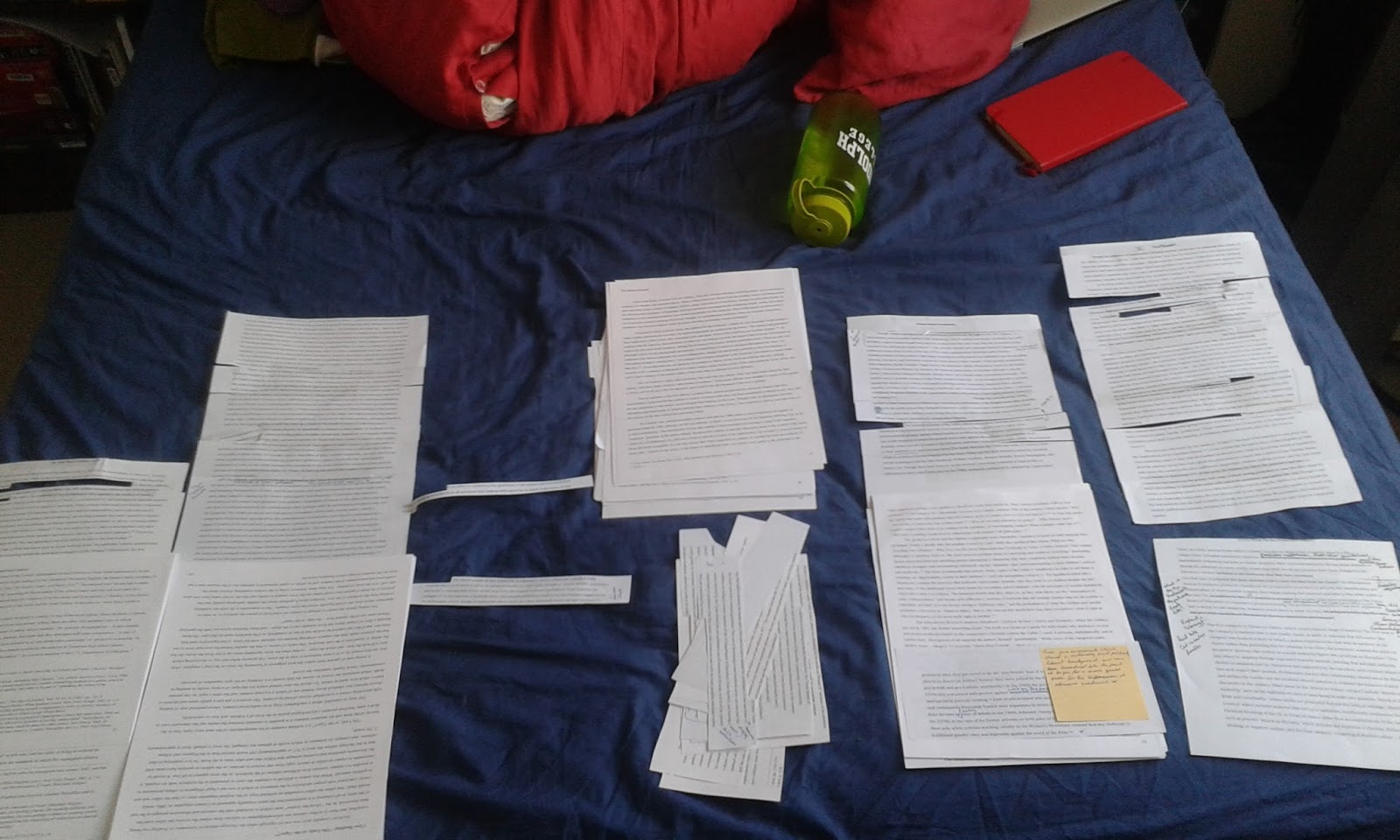 |
| It's kinda depressing to think that that's my critical output for the past three years. |
The risk, of course, is that all of the cutting and pasting and sorting out will take up so much time that the draft will be done in theory when the deadline pops up, but won't have made it back onto the computer. So far that hasn't happened, but I won't be surprised if one day I wind up hand-delivering a nine-foot sheet of taped-together paragraphs in lieu of a Word document.
Wednesday, 2 March 2016
(Not) Procrastinating
I've admitted to myself that continuously refreshing my inbox isn't going to make Jason's notes come any faster, and that hiding under my bed isn't going to make the other work that I should have already done go away, so I've finally settled in to try and do my American taxes. Which are far more confusing than my English taxes, because the tax forms all assume that you're earning in USD, living in the States, and getting all these forms along with your income that don't seem to exist in Britain. Take multiple currencies, add tax years that cover different date ranges, multiply by the number of different income streams, and it will make perfect sense why I've been doing literally anything other than dealing with it.
When I got to be a teenager and started earning money, my parents told me that I shouldn't worry about taxes: my dad would do them until I got married, then my husband would do them until one of us kicked it, and that was the way the world worked. Then when I got to my twenties and had to juggle paying for grad school with a dozen sources of income in four currencies without screwing up enough to land in jail my mom told me to stop stressing about it, my financial situation couldn't possibly be as topsy-turvey as I insisted it was. Now I have an accountant because no one, related by blood or marriage, is willing to touch my taxes without fiscal encouragement, and it's the most I can manage to gather together the documentation; I'd rather go to jail for evasion than file myself.
Come to think of it, my family has a pretty consistent track record for giving me a hard time for worrying about things that they say either won't happen or shouldn't worry me, only for the exact thing I've gotten worked up about to turn out to be exactly as much of an issue as I initially thought it would be. Sometimes it takes weeks, sometimes years, but it seems to always happen - with the exception of my paralysing fear that I'd not get into university.
So I was riffling through my filing cabinet trying to find the documents for the accountant and pulling out writery things for the Archive - and being unprecedentedly proud of myself for not only managing to hang onto all of my payment advice slips from last year, but having them all in the same file AND in the house where the tax doing needs to happen - when I found a bunch of writing from the end of the MA that I'd totally forgotten about. And one of the little bits was a sort of note-to-self in defence of the first person. And since all that sort of thing is going to the Archive I figured it made sense to copy it out here (which is actually why I sat down to write this post in the first place, as opposed to whining about taxes) because it's a question I still haven't heard satisfactorily answered.
A while back I wrote a horror story in which the narrator gets turned into a zombie at the end, and the editor of the anthology it was going in objected to the use of the first person on the grounds that, if the character gets turned into a zombie, how are they narrating the story? Which made me think about the whole idea of first person narrators. Epistolary novels have more or less fallen by the wayside, so in a lot of cases, while a first-person narrator is essentially telling the reader the story, exactly how that is occurring isn't made clear, even if it is technically plausible. In most cases the narrator stays alive to the end, so I suppose it could be argued that they wrote the whole thing down after the fact. Except we all accept that fiction is a construct - the first person narrator isn't the one who has written the story. And so I object to the idea that the question 'how is this person telling us this story?' has to have a logical answer.
What makes less sense? That there's some disembodied consciousness following a bunch of characters around who then records it all once they've offed each other so that an external party can enjoy the account, or that the reader is a parasite in the character's mind and therefore experiencing it all as it happens. Why can't the narrator die at the end? What demands the greater suspension of disbelief: that the narrator dies and yet the narration follows them through death, or the fact that this takes place in a world where black magic is possible and girls can turn their older sisters into zombies?
There aren't many questions that irk me more than 'how is this narration possible?' It's possible because we as a species have developed written language and an appreciation for fiction. It's possible because the narrative hasn't actually been written by the narrator. It exists, therefor it's possible.
Friday, 27 November 2015
Aftermath: way too many words about the past week
We appear to have hit the sudden death round of term. Or that could just be an idiosyncrasy of my calendar and everyone else is bopping along the same as always; I'm never sure.
On Monday I skittered to London, first to sit down with Carrie Plitt and Octavia Bright in the Conville and Walsh office to record a segment for Literary Friction, a monthly conversation about books that airs on NTS and that you really should be listening to, then to Foyles to have a chat with Andrew Holgate ahead of the evening's readings. The turnaround between the judges selecting the winning book and the book being announced in the Sunday Times is apparently a hair's breadth, so he interviewed all four of us with the aim of being able to pop out a write-up of the winner in that gap - respect due for journalistic integrity, but I do not envy him.
Three previous winners of the prize came to speak before the shortlistees, and I just barely managed to not embarrass myself by fawning all over Helen Simpson - "Diary of an Interesting Year" was both an influence for The Shore and used to scar my writing students; "Hey Yeah Right Get a Life" scarred me when I was a student; her stories have been my company back and forth across the ocean and in the darkest parts of sleepless nights - who I never thought I'd have the chance to meet. Andrew Cowan, who I haven't really spoken to since he supervised my MA dissertation, was also there, which was a little odd since I remember exactly nothing from that year and he appears to retain a crystal clear recollection of every moment, which is not a dynamic one wants to have with a director at one's university.
The actual event went well, but the evening ended with Andrew and I running across London and through the underground in an effort to get to Liverpool Street Station in time for the 22.30 train back to Norwich. We made it to the station at 22.27, winded and sans dignity, to find that the train had been cancelled and the next one left at 23.30 and would take three hours to arrive owing to leaves on the track. To cut a long story short, I made it home by 3 AM having shared a drink, a train carriage table, and a taxi with Andrew, and now know far more UEA gossip than I'd thought I ever would.
On Tuesday I woke up with the sudden realisation that, if I wanted to get to London on time for the Guardian ceremony on Wednesday, I'd better leave that afternoon. Autumn is the season of cancelled trains in East Anglia, and I've missed too many important things due to being stranded before. So I dragged myself up to pack, deal with the contents of the refrigerator, do the dishes, put in some laundry, and all of the other little things a body has to do before they leave the house for a week.
Given how little sleep I'd gotten, I was a bit shocked that I managed to get myself in gear and out the door in time to catch the 15.30 train. Which was cancelled. But that was a good thing, because I found when I got to the station that I'd lost my railcard the night before. No one had found it, but they could make me a new one if I could get my hands on a passport photo. So I ran with my suitcase across the road to find a photo booth, cried just enough that the lady at the counter accepted my student card as proof that I was a student, and got on the 16.00 train just before it left. And then realised that I'd left my rings on the counter of the kitchen that my housemate is inevitably going to destroy this weekend, and if he can make tupperware and five gallon slow cookers vanish then a few bands of silver have no chance.
That train was delayed, so when we finally got to London I had to fight my way off against the tide of people trying to get on, even though they had fifteen minutes before the train left to go back to Norwich. I spent twelve of those minutes in the station trying to find dinner before I realised that I'd left my suitcase with all of my work in it on the train, one minute panicking, forty-five seconds sprinting from one end of the station to the other in the hope that the train hadn't left yet, and thirty seconds babbling at rail workers in a panic as I sprinted down the platform, leapt into the carriage I'd ridden down on, ripped the damn suitcase out of the luggage rack, and fell back onto the platform a few seconds before the doors were due to lock.
The next ten minutes were spent in the fetal position on the platform.
So on Wednesday, when nothing happened to prevent me from getting to Blackfriars Bridge to meet Lucy in time to walk over to the OXO building for the Guardian party, I was nothing but relieved. And when we were standing on the stairs waiting to get into the party and talking about who we thought was going to win, all I wanted was to not win because I couldn't scare up any more nerve. And when it came down to it, I knew what book was going to win, because you don't announce a shortlist with "Book of poetry on shortlist for the first time in forever! Oh, there are these other five books, too" when the poetry isn't going to win. And then when it was announced that Physical was the winner I was far more satisfied than I should have been because I'd guessed correctly.
It was an absolutely fantastic party, made just a little bit more fantastic by the fact that I (purposefully) look nothing like the one publicity photo that exists, so I got to spend the first half of the evening chatting with my publishers and my spouse-thing and taking unabashed advantage of our proximity to the door whence the food was issuing, while people who were meant to pin me down for a picture or a chat walked right past holding a reference photo taken when I had red hair. Dave gave the game away when a woman with a massive camera and pictures of all the long-list authors came up and asked him if he was Peter Pomerantsev; it then took him an embarassingly long time to convince her that I am me. At which point I had drunk enough that talking to people wasn't scary at all, and I had a good long natter with several readers and quite a few industry people. I also at that point had no shame. Book events tend to be decorated with books, so several copies of the shortlist books were scattered tastefully around the room; this may or may not bear relationship to the fact that when I got home at 2 in the morning I somehow had the entire shortlist under my arm.
 |
| How did that get there? |
And yesterday evening I had Thanksgiving dinner with my alma mater's study abroad group, caught up on the gossip back at home campus, gave out their class rings, and may have broke down sobbing when we sang the school song at the end of the evening.
So today is, technically, the first day this week that I've got any hope of getting actual work done. But then, the kitchen cabinets could always stand to be alphabetised...
Saturday, 21 November 2015
Back at the ranch...
It may not look like it, but the third year of the PhD has actually kicked off, and I've been actively participating in it. So far, it's been a bit like going to cross the street, successfully dodging an out-of-control car, only to have a sinkhole full of bears open up beneath me the moment I hit the far sidewalk. Suddenly all of the Personal and Professional Development sessions on grant writing and job hunting are relevant and necessary, and a year isn't looking like a whole lot of time to get what I've done so far into the shape of a thesis. At some point in the past month or so the weekly beer-and-bitch session in the grad bar turned into a water-and-plan-this-conference-we-want-to-make-happen session, a different group of people cornered me in the bar while I had a fever and now I'm part of the group running the annual short story contest, and I'm scared to open any of my email inboxes.
The first draft of Belief has been done for long enough that the feeling of accomplishment has worn off, but not so long that I've gotten around to typing it all up, which doesn't matter so much because I'm only allowed to submit 80,000 words of it at maximum. (The fact that I've groused about this at length should surprise exactly nobody). For months now I've been saying, mostly to Henry, that I need to sit down with that first 80k and give them a structural pounding before anything else useful can happen, but for various reasons ("It's summer! School is ages away!! Let's go to this festival and talk to people about books!!!) I've polished up random bits of new material to meet the past few deadlines and weathered the 'you can do better than this' lectures that they elicited.
Ok, it wasn't all laziness and butterflies; my other supervisor gave me the first week of November as the deadline to send her a reasonable draft of a 35 page journal article and I dropped pretty much everything but Shore stuff in order to get it done. Except she's on research leave and I haven't heard back from her since I sent the draft and I'm scared to message again and ask if she's seen it because I know she's going to give me another deadline that I can't make.
But I've finally gotten nervous about the ultimate deadline: October 2016 will mark the end of three years in the program and the beginning of when I'm allowed to submit a thesis. It also marks the end of my funding and the point when I really need to have figured out what I'm going to be doing, professionally speaking, after UEA ejects me from her sacred halls. And between that and Henry's almost telling off the fire appears to be lit beneath my posterior.
So how, exactly, do you turn 160,000-odd rambling first draft words into something that can be turned in without it looking like you're taking the piss? I have no idea, but here's what I'm doing:
It's been two years since I wrote the opening pages of the draft, so I honestly haven't got a clue what happens in the beginning, besides knowing it doesn't look a lot like what's on my outline. So I sat down with the first 100,000 words of the draft and went through, page by page, writing an outline of what actually happens in the book, along with the dates because I am horrible at keeping timelines. Once that was done it was easy to see that I'd jumped all over the timeline while I was writing it, frequently revisiting earlier passages or jumping ahead to scenes I felt like writing. So I cut up the outline (all five pages of it) and put it in the order it was supposed to be in, and then used that as a guide to cut up the actual 100,000 words and put them in the order that I should have had them in in the first place. That was actually the quick part. The past few days and the rest of the weekend have been given over to the slow part: going through a paper copy of the manuscript with a needle-tipped blue pen, marking up all of the places that need to be expanded or moved or have details added, reconciling ages and dates and crossing chunks of needless waffling out, and writing up sticky notes with the details of scenes that need to be added but that I didn't know needed to be added when it was all out of order.
It's incredibly messy, and it does make me wish a little bit that I had written the book chronologically. But I've never really been able to write chronologically; more often than not, it's later scenes that make me realise what ought to have come before. And at any rate, it beats doing taxes.
Subscribe to:
Posts (Atom)