At the end of my viva I was told to sit tight until official notice came through telling me what to do next, and since the uni website said that all I had to do to graduate this summer was make the July 7th pass list, I figured sitting tight was what I'd do. Except sitting tight goes against my nature, and since I happened to be up in Norwich a few weeks ago I figured it wouldn't hurt to drop by the postgrad office and ask them when they thought my marching orders would be appearing. And it was a good thing I did, because the nice lady in the office told me that the deadline for submitting the final copy was actually the 12th of June, or two working days and a weekend from right then, but they were processing forms as fast as they could and with any luck I'd have the letter telling me what to do in time to actually do something about it.
The rub in all that lay in the fact that, while my examiners had told me exactly what changes they wanted me to make to the thesis - delete two sentences, reword a third sentence, and clean up the typos - they hadn't told me definitively if those were gentleman's agreement type corrections, or if they'd be putting them in the official writeup. The difference being that in the first instance I could go ahead and turn in the draft that I'd already corrected, while in the second instance someone would have to sign off on the fact that I'd done the corrections, adding a week or two to the process and putting me well past the hand-in date.
I hate gambling, but in the final analysis it seemed smarter to bet on the letter saying 'pass with no corrections.' At which point I found that the official binder of UEA theses needs a five-day run-up at this time of year. Which meant that I had to find someone else who could bind it overnight and get it to me in time for me to get it to the University before the deadline, still assuming that in all this the paperwork would be processed and I'd be allowed to submit it. Which meant that, rather than handing a pdf of the thesis to someone who knew how UEA likes theirs bound, I got to find someone in Leeds who could do it in a hurry, then weed through several versions of the University regulations trying to figure out exactly in which direction they wanted the spine lettering printed.
Digression: why is it that every time I've had to submit something that adheres to strict specifications - at university, to the border agency, to the taxman - those specifications are so imprecisely worded that, with the best will in the world, I always send in my work with no clue as to whether it actually meets the guidelines? The uni guidelines stated that the bound copy had to have the name of the degree for which it was submitted on the cover, but didn't say whether that meant 'PhD,' 'Doctor of Philosophy,' or 'Doctor of Philosophy in Creative and Critical Writing;' there were points in the documents where that phrase referred to all three terms.
On Friday the 9th I received the bound thesis: it was as black as my mood and the perfect density for bludgeoning. Much later on Friday (about six hours too late to phone up a printer if I'd waited for the official go-ahead) I received the letter that told me that I had passed without corrections, and all I had to do was turn in the bound copy that I fortuitously had. On Sunday I went trudging back up to Norwich, because I've had the trains cancelled on me too often to trust them to be running on a day when I absolutely had to make it through. And on Monday I trudged from where I was staying in town to the Elizabeth Fry building to hand the damn thing over. At which point I found that the office where I was supposed to submit the thing was closed and locked for a school holiday.
Because of course the office is closed on the deadline that determines whether a person makes this year's graduation.
The panicking only lasted as long as it took me to find the staff member chilling in a meeting room two floors down on the off chance that someone wanted to bring in a thesis that day. Since she didn't pull out callipers to check the formatting I figured that any minor misreadings of the guidelines would be allowed to squeak by. But she also didn't give me a receipt, or any guarantee that someone else wouldn't catch an error and I'd have to do it over again. So it wasn't until I got another letter, the one that says, "the following candidate has satisfied the examiners for the award of the degree of Doctor of Philosophy" with my name after it, that I stopped worrying.
So it looks like I'm really finished this time. And it looks like I'll be graduating next month.
And, for the life of me, I don't know how to feel about either of those things.
Showing posts with label Figuring it out. Show all posts
Showing posts with label Figuring it out. Show all posts
Monday, 19 June 2017

Friday, 12 May 2017
Staring down the viva
On Monday Belief finally got to the point that someone else could read it without me immediately dying of shame. So I sent it off to Lucy, only six months later than I originally intended to. It isn't a short book, and it certainly isn't a tidy book just yet, so there's no point eating my fingernails while watching my inbox for guidance on how to make it a tidy book. Which means there's nothing keeping me from prepping for my viva. And since I originally created this blog as a record of my stumblings through higher education, the whole thing would lack symmetry if I didn't record how I'm going to be doing that.
First off, 'viva' is short for 'viva voce,' which in this context is taken to mean 'defending with the living voice.' In the English system the doctoral candidate is usually orally examined on the thesis, and the examination is a factor in whether the candidate passes. In the case of UEA, the examination is performed by one member of the university, and one member from an external university, whose work is related to the subject of the thesis. I've been more than a little annoyed with my fellow Americans in the past couple of months because they can't seem to wrap their minds around this; they think the whole thing is a formality and the hard work was over when I handed in.
As far as prepping for the viva is concerned, the first thing I did was panic, because that's seemingly the first thing everyone does, and because everyone I asked who had already done it told me that the best prep was to pray, bargain, cry, and eat chocolate, which is realistic but not very helpful. The second thing I did was google around to see how people I don't know prepped for theirs, which was marginally more helpful.
The advice I found broke down into two basic categories: know your opponent, and know yourself. A bunch of them are common sense, but when you're panicking even common sense seems like black magic.
1) Hunt up the university's Examiner Report forms, and their guidelines for examiners. They'll outline exactly what constitutes a pass, a pass with corrections, a rewrite, a fail, and any other outcomes the school considers possible. That will let you skew your responses to questions so that they demonstrate your achievement of the benchmarks.
2) Find and read the examiners' work. Get a sense of what they are preoccupied with, what their views might be on your material, and how they build your arguments. In my case, discover that the external has written critical essays on Buffy the Vampire Slayer and immediately fangirl to hell and back.
3) Find out what's been published in your field since you stopped gathering material. In the same vein, make a list of what you left out of the thesis, or the literature review, and be able to defend why.
4) Put together a list of sample questions that might be asked, and start thinking about how you might answer them. There are scads of sample questions out there, all you need to do is Google. Which sounds dirty, out of context.
5) Review the actual thesis. Read the whole thing again. Put in flags to mark where chapter and section breaks are so you don't have to shuffle too much finding them. Highlight important quotes. Make a list of typos as you go through so that you can get right on to correcting them after the viva is over, and so you can strategically bring it out if typos come up in the meeting to let the examiners know that you're on top of them. Write a one-page summary of each chapter of the thesis. Look up how to pronounce words that you're not sure of, or the names of authors whose work you reference.
6) Consider what you're willing to defend to the death, and what's up for compromise. This is probably more dependant on what discipline you're in, and how subjective the work is.
7) Write down the questions that you want to ask the examiners, so you don't forget them on the day.
8) Figure out the practical concerns, such as how you're going to get there on the day.
And that seems to be all that one can realistically do. So I'm going to go off and do it.
And I'm going to eat chocolate while I'm doing it.
First off, 'viva' is short for 'viva voce,' which in this context is taken to mean 'defending with the living voice.' In the English system the doctoral candidate is usually orally examined on the thesis, and the examination is a factor in whether the candidate passes. In the case of UEA, the examination is performed by one member of the university, and one member from an external university, whose work is related to the subject of the thesis. I've been more than a little annoyed with my fellow Americans in the past couple of months because they can't seem to wrap their minds around this; they think the whole thing is a formality and the hard work was over when I handed in.
As far as prepping for the viva is concerned, the first thing I did was panic, because that's seemingly the first thing everyone does, and because everyone I asked who had already done it told me that the best prep was to pray, bargain, cry, and eat chocolate, which is realistic but not very helpful. The second thing I did was google around to see how people I don't know prepped for theirs, which was marginally more helpful.
The advice I found broke down into two basic categories: know your opponent, and know yourself. A bunch of them are common sense, but when you're panicking even common sense seems like black magic.
1) Hunt up the university's Examiner Report forms, and their guidelines for examiners. They'll outline exactly what constitutes a pass, a pass with corrections, a rewrite, a fail, and any other outcomes the school considers possible. That will let you skew your responses to questions so that they demonstrate your achievement of the benchmarks.
2) Find and read the examiners' work. Get a sense of what they are preoccupied with, what their views might be on your material, and how they build your arguments. In my case, discover that the external has written critical essays on Buffy the Vampire Slayer and immediately fangirl to hell and back.
3) Find out what's been published in your field since you stopped gathering material. In the same vein, make a list of what you left out of the thesis, or the literature review, and be able to defend why.
4) Put together a list of sample questions that might be asked, and start thinking about how you might answer them. There are scads of sample questions out there, all you need to do is Google. Which sounds dirty, out of context.
5) Review the actual thesis. Read the whole thing again. Put in flags to mark where chapter and section breaks are so you don't have to shuffle too much finding them. Highlight important quotes. Make a list of typos as you go through so that you can get right on to correcting them after the viva is over, and so you can strategically bring it out if typos come up in the meeting to let the examiners know that you're on top of them. Write a one-page summary of each chapter of the thesis. Look up how to pronounce words that you're not sure of, or the names of authors whose work you reference.
6) Consider what you're willing to defend to the death, and what's up for compromise. This is probably more dependant on what discipline you're in, and how subjective the work is.
7) Write down the questions that you want to ask the examiners, so you don't forget them on the day.
8) Figure out the practical concerns, such as how you're going to get there on the day.
And that seems to be all that one can realistically do. So I'm going to go off and do it.
And I'm going to eat chocolate while I'm doing it.
Friday, 14 October 2016
Italy, Day 1: Treviso
I want to be an adventurer, probably because I read too many books as a kid which focussed on adventurers. The problem with this is that I am, by nature, a timid person who lives in terror of making mistakes and gets along just fine not speaking to another person for days. So when Lucy asked me if I would like to go on a book tour in Italy, the part that has delusions of dragonslaying said yes while the rest was trying to find the courage to say, "...is that such a good idea?" But no one ever became an adventurer by staying home, and I figure if I keep doing things that terrify me then at some point I'll simply run out of terrifying things to do, and then everything will be easy.
Thursday morning I was convinced I'd never make it out of the country: I seem to have a travel curse where Italy is concerned, every plan I make to visit gets cancelled; on top of that I'd come back from the US on Tuesday with a wicked cold and couldn't wrap my head around the travel details that were in English, let alone all of the ones that weren't. In my defence, the times on all of my tickets and the times on my itinerary didn't agree, which would probably make anyone nervous. There was panic about missing my flight on the bus, the train, the tube, the other train, and all through check-in, and then there was a brief respite followed by panic on the flight and all the way to the hotel that I wouldn't go to the right place and there wouldn't be anyone to translate and I'd be sent home in disgrace. There was so much panic over logistics, in fact, that when it actually came time to speak to a roomful of people I couldn't find it in myself to even worry.
The first place I went was Treviso, which everyone described as a small town but which pretty well awed me. It looked like all of the descriptions I've read in novels set in northern Italy, so it was like arriving in a familiar town that I hadn't seen in a long time, which is similar to how I felt coming to Britain for the first time. It probably added to the sense of familiarity that the hotel they put me in was decorated a lot like my aunt's house, down to the gilt wall sconces.
The evening was chaired and translated by a wonderful woman called Rosanna Martinelli, who teaches literature in English and who I found accidentally as I was coming down the stairs of the hotel, determined to be an adventurer and do some adventuring, just as she was coming up the stairs to find me since I hadn't answered my room phone. Live translation is difficult and time-consuming in the best circumstances, so we plotted out a good part of the discussion beforehand, so that she could focus on translating what I said into Italian without having to translate everything she said into English first. The evening was held in a gorgeous medieval building (as close as I can tell) and seemed to go over well - there were quite a few questions and several very positive comments. So all in all day one went much better than expected. And I managed to get coffee and get myself on the correct train this morning, so so far I'm ten for ten if you ignore the cold.
 |
| A canal in the rain. |
Thursday morning I was convinced I'd never make it out of the country: I seem to have a travel curse where Italy is concerned, every plan I make to visit gets cancelled; on top of that I'd come back from the US on Tuesday with a wicked cold and couldn't wrap my head around the travel details that were in English, let alone all of the ones that weren't. In my defence, the times on all of my tickets and the times on my itinerary didn't agree, which would probably make anyone nervous. There was panic about missing my flight on the bus, the train, the tube, the other train, and all through check-in, and then there was a brief respite followed by panic on the flight and all the way to the hotel that I wouldn't go to the right place and there wouldn't be anyone to translate and I'd be sent home in disgrace. There was so much panic over logistics, in fact, that when it actually came time to speak to a roomful of people I couldn't find it in myself to even worry.
 |
| A different canal in the rain. |
The first place I went was Treviso, which everyone described as a small town but which pretty well awed me. It looked like all of the descriptions I've read in novels set in northern Italy, so it was like arriving in a familiar town that I hadn't seen in a long time, which is similar to how I felt coming to Britain for the first time. It probably added to the sense of familiarity that the hotel they put me in was decorated a lot like my aunt's house, down to the gilt wall sconces.
 |
| It's probably time to get a new camera: that's a marble floor, the doors are marquetry, and the furniture is antique. Also, gilt everywhere. |
 |
| I'm pretty sure my aunt has actually had those wall sconces at some point. The marble-topped nightstand and alligator album she's definitely had. |
 |
| My mom asked for pictures. Hi Mom! |
Monday, 26 September 2016
All things must come to an end
Today is the first day of my last term as a student (unless I bollocks it up) and marks four solid years since I came to Norwich, sight unseen, armed with a blank notebook, a woollen jacket of insufficient thickness, and the intention of whacking my head against the metaphorical wall until one of the two broke or someone made me stop. Looking back, I'm shocked that it was the wall that gave way, rather than my head, and not just the wall of the university's ivory tower but that of publishing's looming fortress: I never thought I'd make it this far.
I came to Norwich in 2012 with the hope that I'd get a year to breathe: to write, to recover from the illness that had kept me pretty near insensate for six months, to spend time in a country I loved but didn't think would have me and in the same timezone as someone who I loved but who wouldn't let me compromise on my goals for it. I've stayed for longer than I planned, done more than I thought was possible - in fact, pretty much everything I dreamed of doing, except for the 'breathing and resting' part. I thought by now I'd be back in the States, working a dead-end job with health insurance too expensive to actually use and writing stories no one would ever read in my free time. I still feel like an impostor, but it's a simple fact that, if I am, I'm an impostor with two published novels and a thesis in its final stage of revisions, who trembles at the unknown but jumps into it anyway on the off chance that it will be interesting.
At the end of December I should be turning in my thesis and moving down to Reading. What happens after that, I'm not sure - doubtless the viva and the revisions and the handing in of the final dissertation will take up a lot of time and account for endless fannying about. I'm looking forward to waking up in the same town every morning for a month, and I keep daydreaming about what I'll do when I'm finished, making little lists of the books I want to read and places I want to explore and foods I want to feed Dave while I'm in the post-handin limbo. After that, who knows?
Already I'm sad about the prospect of leaving Norwich. It's been a lovely place to become an adult. It's been a good place to become a writer. I hope it will be a great place to come back to, just as much as I hope I'll have plenty of reasons to come back.
It's not over yet though. And tonight, there will be fencing.
I came to Norwich in 2012 with the hope that I'd get a year to breathe: to write, to recover from the illness that had kept me pretty near insensate for six months, to spend time in a country I loved but didn't think would have me and in the same timezone as someone who I loved but who wouldn't let me compromise on my goals for it. I've stayed for longer than I planned, done more than I thought was possible - in fact, pretty much everything I dreamed of doing, except for the 'breathing and resting' part. I thought by now I'd be back in the States, working a dead-end job with health insurance too expensive to actually use and writing stories no one would ever read in my free time. I still feel like an impostor, but it's a simple fact that, if I am, I'm an impostor with two published novels and a thesis in its final stage of revisions, who trembles at the unknown but jumps into it anyway on the off chance that it will be interesting.
At the end of December I should be turning in my thesis and moving down to Reading. What happens after that, I'm not sure - doubtless the viva and the revisions and the handing in of the final dissertation will take up a lot of time and account for endless fannying about. I'm looking forward to waking up in the same town every morning for a month, and I keep daydreaming about what I'll do when I'm finished, making little lists of the books I want to read and places I want to explore and foods I want to feed Dave while I'm in the post-handin limbo. After that, who knows?
Already I'm sad about the prospect of leaving Norwich. It's been a lovely place to become an adult. It's been a good place to become a writer. I hope it will be a great place to come back to, just as much as I hope I'll have plenty of reasons to come back.
It's not over yet though. And tonight, there will be fencing.
Monday, 4 July 2016
Thesis mode
My memory is odd. Looking back I get the impression that I've spent the last six months in general idleness, avoiding work and skiving off, and present Sara hates past Sara because of it, because when the looking back occurs present Sara is usually hustling to meet a deadline and wondering why past Sara didn't take care of it. But when I flip back through my diary it becomes clear why past Sara didn't take care of it, because past Sara generally does far more hustling of other types than present Sara remembers.
Today was the day that the first rough draft of my critical thesis was due to my supervisor. A week ago today was the day that I actually began working on it, because in the month before that I owed Henry 20,000 words, taught for FLY, presented at a conference, spent a week in the US doing research, judged a short fiction prize, had Annual Progress Review, and more or less kept up with the planning of my own conference. So the acrimony directed at past Sara was generally groundless, as very little skiving took place.
I've been writing up my research periodically as I've gone along, more as notes on what I've done than as actual readable material, and I've churned out a handful of self-contained pieces, so writing the first draft was less 'writing' than 'figuring out what part of what I already had was useable.' And if I'm bad at remembering what I've done, I'm even worse at remembering what I've already included in a document. So instead of approaching the thesis with any dignity, I took the arts-and-crafts line of attack:
The whole was finished and sent at about ten this morning, with much fear and trembling because it's both far longer than my supervisor is expecting and far rougher than I was hoping it would be. Though, when I first sat down a week ago and looked at what I had, I hid under the desk and refused to come out because I thought I had absolutely nothing to show for the past three years, so I suppose I'm in a 100% better position than I expected to be.
Today was the day that the first rough draft of my critical thesis was due to my supervisor. A week ago today was the day that I actually began working on it, because in the month before that I owed Henry 20,000 words, taught for FLY, presented at a conference, spent a week in the US doing research, judged a short fiction prize, had Annual Progress Review, and more or less kept up with the planning of my own conference. So the acrimony directed at past Sara was generally groundless, as very little skiving took place.
I've been writing up my research periodically as I've gone along, more as notes on what I've done than as actual readable material, and I've churned out a handful of self-contained pieces, so writing the first draft was less 'writing' than 'figuring out what part of what I already had was useable.' And if I'm bad at remembering what I've done, I'm even worse at remembering what I've already included in a document. So instead of approaching the thesis with any dignity, I took the arts-and-crafts line of attack:
 |
| Print it out, cut it up, sort like with like, put it back together, throw away the extra pieces. Just like Ikea. |
I don't remember when I started doing it this way - no surprise there - but 'cut it all up and put it back together in an order that makes sense' seems to be the only way that I produce nonfiction that's in any way readable.
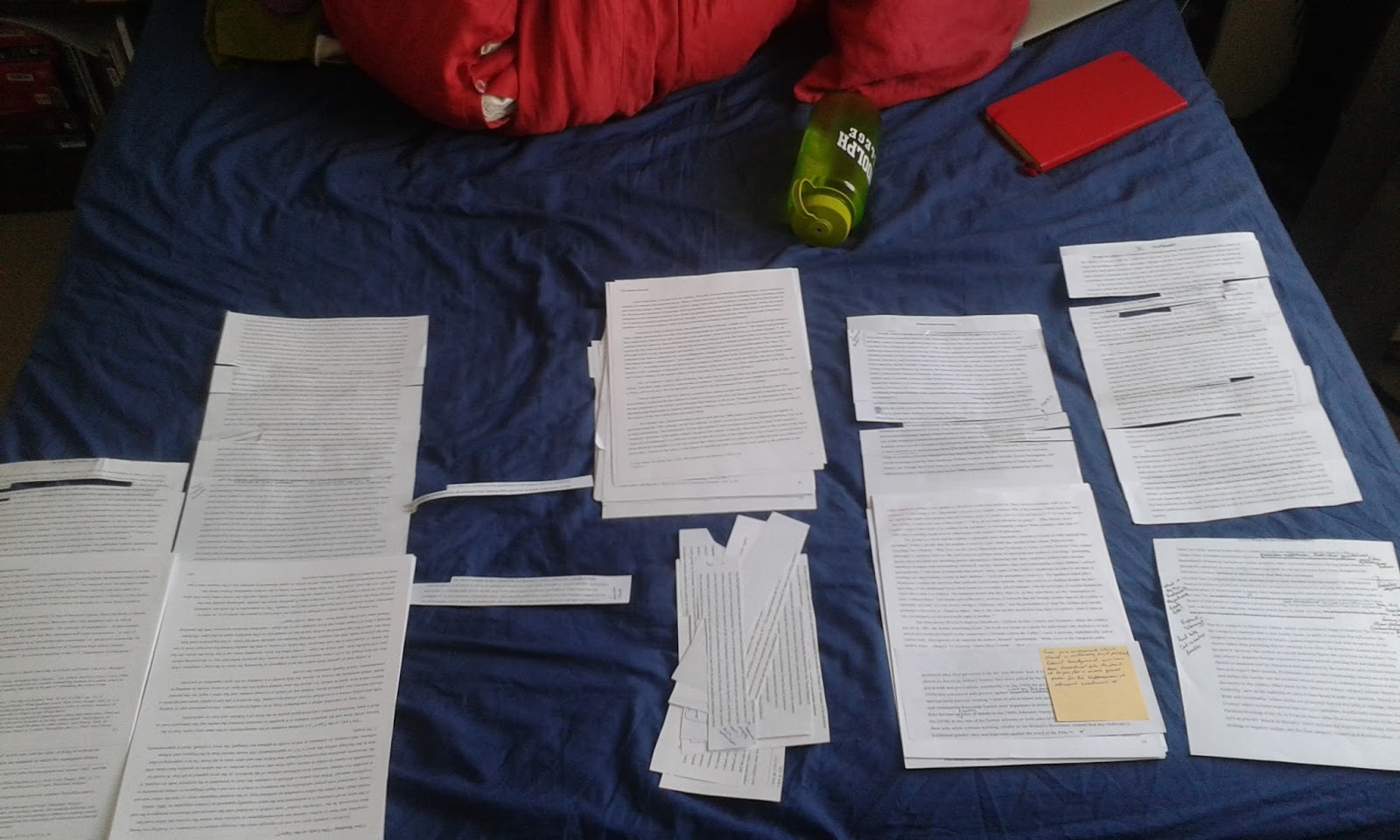 |
| It's kinda depressing to think that that's my critical output for the past three years. |
The risk, of course, is that all of the cutting and pasting and sorting out will take up so much time that the draft will be done in theory when the deadline pops up, but won't have made it back onto the computer. So far that hasn't happened, but I won't be surprised if one day I wind up hand-delivering a nine-foot sheet of taped-together paragraphs in lieu of a Word document.
Thursday, 23 June 2016
FLY
Once a year, the professor who convened the first literature module I ever taught organises and executes the week-long Festival of Literature for Young People, or FLY for short. There are speakers and workshops and games for kids of school age, and it seems to be both madly popular and madly successful - my housemate remarked when he got in yesterday evening that half his school seems to have been signed out for it.
UEA being what it is, a fair number of the volunteers are from its hallowed halls, including the workshop teachers. And since, when the email went around six months ago asking for teachers signing up seemed like a good idea, I got to field a batch of sixth formers this afternoon.
Under normal circumstances this wouldn't have born reporting, but I haven't taught in months now, and I haven't been in Norwich in weeks. Which means that I didn't get around to planning until yesterday, and even though the session wasn't until the afternoon I had to get to campus immediately post-breakfast so that I could wait in the medical centre for an hour to eventually be told that all seemed well and see you again in six months. So it should surprise no one but me that, immediately after being told I was healthy and skittering off to the postgrad cafe to drink coffee and wait for my teaching slot, I realised that not only had I forgotten to bring the bag full of random items necessary for my three favourite writing exercises, but that I'd completely forgotten that such a bag needed to be put together.
I live a thirty minute walk away from the university. Today is one of those strange days you seem to get in England, where it's hot enough that one sweats, but too cool for shorts and sleevelessness; it's sunny enough to burn, but too cloudy to tan; every time I take my jacket off it starts raining, and every time I put it on it stops, and there's so much ambient moisture that all of that sweat just sits on your skin, like an oil slick. Also, I haven't been in Norwich for a while, so only my teaching clothes seem to be here. Teaching clothes bought intentionally for Norfolk winters, when I usually find myself teaching. Which explains why I wound up running from school to home and back again while dressed head to toe in black, and might begin to explain exactly how all-fire uncomfortable that was.
An aside for foreign readers: aircon isn't a thing here the way it is in the U.S.
The actual teaching went better than I hoped, at least. The students were a bit reticent, but they wrote, and they seemed to like the exercises I gave them. The best part for me, as always, was getting to hear some of the things they came up with; there wasn't a dud in the bunch.
Sunday, 12 June 2016
Missing in Action
At the moment I'm sitting in a surprisingly large hotel room in Morristown, New Jersey, trying to find the will to sort my suitcase out, because it's going to have to be dropped tomorrow morning into the trunk of a car that's not mine and transported to the airport. I'm naturally going with it, but since nobody is going to be weighing me on arrival I require much less sorting.
Yesterday afternoon I presented the paper that I dropped off the face of the earth a few weeks ago to write as part of a panel dealing with censorship in public education. The room was surprisingly full, the questions were interesting and answerable, and I've finally met another human being who spends a horrifying amount of their time looking at textbooks. And since I presented on the first day, I got to spend today actually enjoying other peoples' papers instead of trembling in the corner with nerves. Even with the trembling, it was wonderful to finally feel as though I'm a part of an academic community; my research doesn't have much in common with that of the rest of my cohort, so a lot of the time I feel like the madwoman in the corner, pegging away at something that no one cares about. Meeting even one person who already gets it, let alone over a dozen, was worth the distance travelled.
This is probably the most productive trip I've ever been on: about two weeks ago I flew into DC and bribed my younger sister to drive me so that I could do a final round of location research for Belief, then spent nearly a week harassing relatives about their memories of their misspent youths, also for Belief, then dragged myself several states north for the conference. And now I get to skedaddle back to England to do something with it all before too much time passes and I can't understand my own notes.
And, of course, get back to helping organise a conference at UEA for this December. I'm sure the other plotters are just thrilled with my recent inability to answer email.
Yesterday afternoon I presented the paper that I dropped off the face of the earth a few weeks ago to write as part of a panel dealing with censorship in public education. The room was surprisingly full, the questions were interesting and answerable, and I've finally met another human being who spends a horrifying amount of their time looking at textbooks. And since I presented on the first day, I got to spend today actually enjoying other peoples' papers instead of trembling in the corner with nerves. Even with the trembling, it was wonderful to finally feel as though I'm a part of an academic community; my research doesn't have much in common with that of the rest of my cohort, so a lot of the time I feel like the madwoman in the corner, pegging away at something that no one cares about. Meeting even one person who already gets it, let alone over a dozen, was worth the distance travelled.
This is probably the most productive trip I've ever been on: about two weeks ago I flew into DC and bribed my younger sister to drive me so that I could do a final round of location research for Belief, then spent nearly a week harassing relatives about their memories of their misspent youths, also for Belief, then dragged myself several states north for the conference. And now I get to skedaddle back to England to do something with it all before too much time passes and I can't understand my own notes.
And, of course, get back to helping organise a conference at UEA for this December. I'm sure the other plotters are just thrilled with my recent inability to answer email.
Friday, 13 May 2016
Marshalling the Forces
Besides writing a thesis, PGR students are supposed to hit a bunch of smaller benchmarks in order to be considered to have successfully finished the program. Some of them are stupid easy, such as earning the requisite professional development credits, which most of us do completely by accident and without plan. Others are more difficult, such as getting an article published in a reputable academic journal, which sounds like it's tough even for the professionals who have been playing this game for years. My personal Waterloo on that front has been finding a conference. I've run into ones on law, politics, education, childhood, but none of them had calls to which I could tailor my critical work enough to have a dream of getting accepted. The thing that made it even more frustrating was that they all seemed to be held places like Hawaii, Mauritius, Japan - the kinds of places that I'd kill to have a legitimate work reason to visit.
So imagine how ecstatic I was when I finally found a conference for which my work was suited. And imagine how much more ecstatic I was when they actually accepted my paper proposal.
So, what's the catch?
It's in New Jersey.
Not even old Jersey, but New Jersey, where approximately 80% of my relatives live, where I've been dragged for weddings and christenings since before I was old enough to realise that even the people who live there aren't exactly crazy about the place. No offence to anyone, but I hate New Jersey. I can practically hear the gods laughing.
Now that I have a place to give a paper, I actually have to write it. They only allow presenters twenty minutes apiece, so it isn't going to be that long, and it is delivered verbally, so the usual rhetorical stylings and five-dollar language goes out the window in favour of clarity and simplicity. You'd think that would make it all easier. For some reason, the mere idea of getting started is terrifying me. Maybe my Everest of secondary sources has something to do with it.
 |
| Yes, that is a blackbird. Yes, he is hanging upside down. I don't know why, ask him. |
As things go, the timing is really fantastic. Annual Review has just been, and the major decision made therein was that I'd hand over a full draft of the critical thesis in September. Which means that I need to sequester myself over the summer and write it. And what better way to get into the groove of writing a thesis than by writing a smaller, simpler, more straightforward portion of one of its main arguments? The secondary sources (pictured above; probably overkill) have been gathered, the calendar has been cleared, the outlines have been drawn up. There is absolutely nothing stopping me from hammering out both conference paper and critical thesis.
It probably means a lot that instead of actually beginning the paper, I pulled up a web browser and wrote a blog post.
Somebody send reinforcements.
Monday, 4 April 2016
From pillar to post
The deadline to send a more-or-less final version of The Lauras back to everyone who had sent me notes so that the copyeditor can get started on it and a proof can be made was this morning. Which means that I spent Sunday sat on the living room sofa making final tweaks and then forcing Dave to read them and tell me whether they made logical sense before sending the final copy out to all and sundry and wandering off to watch Trainspotting in a state of post-revision limpness. Of course, everyone's firewall ate my email, which led to distressed pre-coffee phone calls and several moments of panic. But now the draft is finally in the hands of all who need it, and I can go back to everything that's been neglected in the past two weeks.
It's technically Easter holiday for the university but, as I keep telling my family, that means pretty much diddly for postgrads, so a lot of this edit was done on the train back and forth to Norwich and in between thesis and conference planning meetings. And if that didn't complicate the process enough, my spellcheck decided to be Dutch the day I started work.
It's technically Easter holiday for the university but, as I keep telling my family, that means pretty much diddly for postgrads, so a lot of this edit was done on the train back and forth to Norwich and in between thesis and conference planning meetings. And if that didn't complicate the process enough, my spellcheck decided to be Dutch the day I started work.
 |
| Those are the suggested corrections for the word 'if.' Never have I so questioned my ability to spell. |
So it's a good thing that there's going to be a copyeditor looking at the book before anyone else does, because not only am I very inconsistent when it comes to language usage, but I really, really, really cannot spell. And apparently my computer can't either at the moment.
It's kinda sad that I'm actually excited to go off and read Foucault.
Wednesday, 2 March 2016
(Not) Procrastinating
I've admitted to myself that continuously refreshing my inbox isn't going to make Jason's notes come any faster, and that hiding under my bed isn't going to make the other work that I should have already done go away, so I've finally settled in to try and do my American taxes. Which are far more confusing than my English taxes, because the tax forms all assume that you're earning in USD, living in the States, and getting all these forms along with your income that don't seem to exist in Britain. Take multiple currencies, add tax years that cover different date ranges, multiply by the number of different income streams, and it will make perfect sense why I've been doing literally anything other than dealing with it.
When I got to be a teenager and started earning money, my parents told me that I shouldn't worry about taxes: my dad would do them until I got married, then my husband would do them until one of us kicked it, and that was the way the world worked. Then when I got to my twenties and had to juggle paying for grad school with a dozen sources of income in four currencies without screwing up enough to land in jail my mom told me to stop stressing about it, my financial situation couldn't possibly be as topsy-turvey as I insisted it was. Now I have an accountant because no one, related by blood or marriage, is willing to touch my taxes without fiscal encouragement, and it's the most I can manage to gather together the documentation; I'd rather go to jail for evasion than file myself.
Come to think of it, my family has a pretty consistent track record for giving me a hard time for worrying about things that they say either won't happen or shouldn't worry me, only for the exact thing I've gotten worked up about to turn out to be exactly as much of an issue as I initially thought it would be. Sometimes it takes weeks, sometimes years, but it seems to always happen - with the exception of my paralysing fear that I'd not get into university.
So I was riffling through my filing cabinet trying to find the documents for the accountant and pulling out writery things for the Archive - and being unprecedentedly proud of myself for not only managing to hang onto all of my payment advice slips from last year, but having them all in the same file AND in the house where the tax doing needs to happen - when I found a bunch of writing from the end of the MA that I'd totally forgotten about. And one of the little bits was a sort of note-to-self in defence of the first person. And since all that sort of thing is going to the Archive I figured it made sense to copy it out here (which is actually why I sat down to write this post in the first place, as opposed to whining about taxes) because it's a question I still haven't heard satisfactorily answered.
A while back I wrote a horror story in which the narrator gets turned into a zombie at the end, and the editor of the anthology it was going in objected to the use of the first person on the grounds that, if the character gets turned into a zombie, how are they narrating the story? Which made me think about the whole idea of first person narrators. Epistolary novels have more or less fallen by the wayside, so in a lot of cases, while a first-person narrator is essentially telling the reader the story, exactly how that is occurring isn't made clear, even if it is technically plausible. In most cases the narrator stays alive to the end, so I suppose it could be argued that they wrote the whole thing down after the fact. Except we all accept that fiction is a construct - the first person narrator isn't the one who has written the story. And so I object to the idea that the question 'how is this person telling us this story?' has to have a logical answer.
What makes less sense? That there's some disembodied consciousness following a bunch of characters around who then records it all once they've offed each other so that an external party can enjoy the account, or that the reader is a parasite in the character's mind and therefore experiencing it all as it happens. Why can't the narrator die at the end? What demands the greater suspension of disbelief: that the narrator dies and yet the narration follows them through death, or the fact that this takes place in a world where black magic is possible and girls can turn their older sisters into zombies?
There aren't many questions that irk me more than 'how is this narration possible?' It's possible because we as a species have developed written language and an appreciation for fiction. It's possible because the narrative hasn't actually been written by the narrator. It exists, therefor it's possible.
When I got to be a teenager and started earning money, my parents told me that I shouldn't worry about taxes: my dad would do them until I got married, then my husband would do them until one of us kicked it, and that was the way the world worked. Then when I got to my twenties and had to juggle paying for grad school with a dozen sources of income in four currencies without screwing up enough to land in jail my mom told me to stop stressing about it, my financial situation couldn't possibly be as topsy-turvey as I insisted it was. Now I have an accountant because no one, related by blood or marriage, is willing to touch my taxes without fiscal encouragement, and it's the most I can manage to gather together the documentation; I'd rather go to jail for evasion than file myself.
Come to think of it, my family has a pretty consistent track record for giving me a hard time for worrying about things that they say either won't happen or shouldn't worry me, only for the exact thing I've gotten worked up about to turn out to be exactly as much of an issue as I initially thought it would be. Sometimes it takes weeks, sometimes years, but it seems to always happen - with the exception of my paralysing fear that I'd not get into university.
So I was riffling through my filing cabinet trying to find the documents for the accountant and pulling out writery things for the Archive - and being unprecedentedly proud of myself for not only managing to hang onto all of my payment advice slips from last year, but having them all in the same file AND in the house where the tax doing needs to happen - when I found a bunch of writing from the end of the MA that I'd totally forgotten about. And one of the little bits was a sort of note-to-self in defence of the first person. And since all that sort of thing is going to the Archive I figured it made sense to copy it out here (which is actually why I sat down to write this post in the first place, as opposed to whining about taxes) because it's a question I still haven't heard satisfactorily answered.
A while back I wrote a horror story in which the narrator gets turned into a zombie at the end, and the editor of the anthology it was going in objected to the use of the first person on the grounds that, if the character gets turned into a zombie, how are they narrating the story? Which made me think about the whole idea of first person narrators. Epistolary novels have more or less fallen by the wayside, so in a lot of cases, while a first-person narrator is essentially telling the reader the story, exactly how that is occurring isn't made clear, even if it is technically plausible. In most cases the narrator stays alive to the end, so I suppose it could be argued that they wrote the whole thing down after the fact. Except we all accept that fiction is a construct - the first person narrator isn't the one who has written the story. And so I object to the idea that the question 'how is this person telling us this story?' has to have a logical answer.
What makes less sense? That there's some disembodied consciousness following a bunch of characters around who then records it all once they've offed each other so that an external party can enjoy the account, or that the reader is a parasite in the character's mind and therefore experiencing it all as it happens. Why can't the narrator die at the end? What demands the greater suspension of disbelief: that the narrator dies and yet the narration follows them through death, or the fact that this takes place in a world where black magic is possible and girls can turn their older sisters into zombies?
There aren't many questions that irk me more than 'how is this narration possible?' It's possible because we as a species have developed written language and an appreciation for fiction. It's possible because the narrative hasn't actually been written by the narrator. It exists, therefor it's possible.
Tuesday, 19 January 2016
Revision and paperback
I've been eaten by revisions. Which is preferable to being eaten by my thesis; at least my editor gives positive feedback. Last Monday I sat down and rewrote the first thirty pages. On Tuesday I realised that the rewrite was crap and re-rewrote the first thirty pages. On Wednesday I woke up with the conviction that the version from a year ago was actually much better than I first thought and used it to rewrite the re-rewrite. This weekend Dave went down to Brighton and I stayed home and did my night-owl thing and managed to hit the halfway point.
People have said that the reason it's called 'revision' is that it's a process of re-seeing, more than rewriting. You have to see what's on the page with clear eyes before you can know what it needs to make it better. In my case it's more a process of re-digesting; now that I've gotten to the midpoint the little voice in my head keeps chiming in with comments like 'you know, what you really need to do to chapter 2 is...' And then I have to go back to chapter 2, which does usually make chapter 2 better but makes the whole longer, which is a problem in its own right because the whole needs to lose about twenty thousand words of deadweight before it can be called finished.
About the point last week where I was despairing of ever getting to page 31, I got a surprise through the mail slot:
I've got a weakness for book-related art. It's not so common to find people's impression of a book transmuted into another form, and seeing how someone else would present my work visually makes me as excited as the existence of the physical book does. Which is a level of excited that is pretty difficult to touch; I've got a weakness for paperbacks.
 |
| Behold: the editorial notes. Though about two pages of that is notes to self. |
People have said that the reason it's called 'revision' is that it's a process of re-seeing, more than rewriting. You have to see what's on the page with clear eyes before you can know what it needs to make it better. In my case it's more a process of re-digesting; now that I've gotten to the midpoint the little voice in my head keeps chiming in with comments like 'you know, what you really need to do to chapter 2 is...' And then I have to go back to chapter 2, which does usually make chapter 2 better but makes the whole longer, which is a problem in its own right because the whole needs to lose about twenty thousand words of deadweight before it can be called finished.
About the point last week where I was despairing of ever getting to page 31, I got a surprise through the mail slot:
 |
| It has spot gloss |
 |
| And creepy people |
I've got a weakness for book-related art. It's not so common to find people's impression of a book transmuted into another form, and seeing how someone else would present my work visually makes me as excited as the existence of the physical book does. Which is a level of excited that is pretty difficult to touch; I've got a weakness for paperbacks.
 |
| The innards have been dressed up, too! |
Tuesday, 1 December 2015
Wall
I'm sitting at my desk for the ninth semi-consecutive hour of the day looking at the two undergraduate dissertations that I need to ink up in time to talk to their authors tomorrow about all the comments made on the earlier drafts that they somehow neglected to incorporate.

Earlier today I was the only person in a professional developments session on networking that wasn't a first year or running the thing. They were all so hopeful. And neatly dressed. And they all knew what their thesises (thesii?) were on. And they wanted to talk about how intimidating it was composing emails to their supervisors. And afterwards I saw them all eating pretty lunches in the postgrad space while socialising.

And I hadn't brushed my hair because I couldn't find my hairbrush and I was wearing the same clothes I wore down on the train yesterday and I hadn't packed a lunch because there was no food in the house to pack and I'd had anti-inflammatories for breakfast because spending that long on the train always makes my back cranky and I avoided them all because I had to mark up those dissertations before I ran out of steam for the day. Which, as is probably obvious, doesn't seem to have happened.

I might be inordinately proud of the fact that I didn't strangle any of them. Heck, I didn't even snap at them.
And now I'm alternating between looking at the dissertations but not marking them up and looking at the draft I owe Henry but not revising it, and taking occasional breaks to think about the work I was supposed to have done for Rachel by now and wondering if she's noticed either the draft I sent her at the beginning of November or that there hasn't been anything from me since.

I may have also paused to arrange my coterie of sock owls into comforting configurations.
There's obviously only one thing to do in this situation...


and find something relevant. Because my downloads folder always has something relevant.


And I hadn't brushed my hair because I couldn't find my hairbrush and I was wearing the same clothes I wore down on the train yesterday and I hadn't packed a lunch because there was no food in the house to pack and I'd had anti-inflammatories for breakfast because spending that long on the train always makes my back cranky and I avoided them all because I had to mark up those dissertations before I ran out of steam for the day. Which, as is probably obvious, doesn't seem to have happened.
I might be inordinately proud of the fact that I didn't strangle any of them. Heck, I didn't even snap at them.
And now I'm alternating between looking at the dissertations but not marking them up and looking at the draft I owe Henry but not revising it, and taking occasional breaks to think about the work I was supposed to have done for Rachel by now and wondering if she's noticed either the draft I sent her at the beginning of November or that there hasn't been anything from me since.

 |
| The little one in the middle is squeaking 'you can do it!' Or possibly, 'if you don't do it I will invade your dreams with a machete and make you wish you had!' |

And that is to leaf through my downloads folder

and find something relevant. Because my downloads folder always has something relevant.

And then probably wander into the kitchen,
find something vaguely good-tasting,

make a drink,

And then see how long these dissertations take me.
Saturday, 7 November 2015
Parisot in retrospect: the most fun I've had in ages.
A few Fridays ago we got up at about three in the morning so we could get a taxi to the station to get the train to Gatwick to get the plane to Toulouse to drive to Parisot. Ok, Dave was the one doing the driving because if the idea of me driving anywhere other than the wide, straight, empty roads of the USA doesn't scare everyone (besides my mother) it should. I've been to Paris a few more times than I'd have liked, but I'd never seen France proper before this trip; all the fuss that people make over the place finally makes sense.
Parisot itself is a relatively small place, which reminded me of the crossroads where my parents live: the local restaurant, a few public buildings, houses tucked away from the main road. Except there was also a bakery with pain au chocolate so good I would willingly eat nothing else for the rest of my life. And mountains. And I didn't have the feeling that I'd be run off with a shotgun if I got too near someone's front porch. So, in essence, it was nothing like where my parents live unless you count the crossroads.
Since we were so far afield the speakers, the organisers, and a lot of the attendees ate together for most of the three days of the festival, which meant that the book chat began with the first arrival and didn't end until after the final speaker departed. Who was, by the by, Kate Mosse, who I'd never gotten to see before and would walk barefoot on hot blacktop to see again, talking about the importance of place to her Languedoc trilogy and her preparation and writing of The Taxidermist's Daughter. Another of the authors who spoke that weekend was Helen Dunmore, who I'd be equally willing to walk barefoot on hot blacktop to see again and who I found myself sitting next to at lunch more frequently that I'd thought possible. Though I was captivated by what they both said, it was interesting for me to watch the way in which they conducted both their talks and themselves. Like it or not, everyone needs a public face, authors probably more than other people because our private faces tend to be wholly unsuited to outdoor wear. And while plenty of people have shared their opinions on what that public face shouldn't look like (don't 'um', don't curse, don't say you have a grudge against Philip Pullman, etc.) not many have given indications what it should look like. So getting the chance to watch - Mosse with birdlike energy and bounciness, Dunmore with calm power - how women that know what they're doing do it was possibly the best part of the weekend.
After the glorious weekend of food and books we had a few days spare to poke around, so we went to Albi to see the cathedral and hear about religious oppression, and then we went to Carcassonne and heard about more religious oppression, so by the time I was getting back on the plane I'd about had it with religion in general and popes in particular. And immediately upon returning I came down with a cold, and the day after that cleared up I came down with a fever, so I'm not really sure what day it is or what's happened since France; the only sure thing is that I would desperately like to go to the festival again some year.
(If I can get my act together and get my hands on David's camera I might sling up some pictures of it all)
Parisot itself is a relatively small place, which reminded me of the crossroads where my parents live: the local restaurant, a few public buildings, houses tucked away from the main road. Except there was also a bakery with pain au chocolate so good I would willingly eat nothing else for the rest of my life. And mountains. And I didn't have the feeling that I'd be run off with a shotgun if I got too near someone's front porch. So, in essence, it was nothing like where my parents live unless you count the crossroads.
Since we were so far afield the speakers, the organisers, and a lot of the attendees ate together for most of the three days of the festival, which meant that the book chat began with the first arrival and didn't end until after the final speaker departed. Who was, by the by, Kate Mosse, who I'd never gotten to see before and would walk barefoot on hot blacktop to see again, talking about the importance of place to her Languedoc trilogy and her preparation and writing of The Taxidermist's Daughter. Another of the authors who spoke that weekend was Helen Dunmore, who I'd be equally willing to walk barefoot on hot blacktop to see again and who I found myself sitting next to at lunch more frequently that I'd thought possible. Though I was captivated by what they both said, it was interesting for me to watch the way in which they conducted both their talks and themselves. Like it or not, everyone needs a public face, authors probably more than other people because our private faces tend to be wholly unsuited to outdoor wear. And while plenty of people have shared their opinions on what that public face shouldn't look like (don't 'um', don't curse, don't say you have a grudge against Philip Pullman, etc.) not many have given indications what it should look like. So getting the chance to watch - Mosse with birdlike energy and bounciness, Dunmore with calm power - how women that know what they're doing do it was possibly the best part of the weekend.
After the glorious weekend of food and books we had a few days spare to poke around, so we went to Albi to see the cathedral and hear about religious oppression, and then we went to Carcassonne and heard about more religious oppression, so by the time I was getting back on the plane I'd about had it with religion in general and popes in particular. And immediately upon returning I came down with a cold, and the day after that cleared up I came down with a fever, so I'm not really sure what day it is or what's happened since France; the only sure thing is that I would desperately like to go to the festival again some year.
(If I can get my act together and get my hands on David's camera I might sling up some pictures of it all)
Friday, 25 September 2015
The next book
When Heinemann offered on The Shore I had a sneaking suspicion that it was a one-time triumph, and that after that first book was done and dusted I'd have to resign myself to an adulthood of actual adulting, and that any books that I happened to write after that would wind up in a desk drawer. So I am very pleasantly surprised that this isn't going to be the case just yet. The roadtrip novel I spent the summer busily revising (and for which no one, including the staff and editors at two publishing houses, can come up with a satisfactory name) has been picked up by Jason Arthur at Heinemann, and should be released (hopefully with a staggeringly beautiful title) in the summer of 2016.
The timeline for this one is much tighter than for the first - I should be dragging myself through edits before the year is over, hopefully while not under the influence of prescription anything this time, and all in all it looks like there will be a lot more hustling and a lot less sitting around. Two books in as many years is not usual in literary fiction - and my other work is showing why quite clearly - so it will probably be a while before Belief surfaces. This time around I feel a lot more relaxed about the whole thing, since I know how it all generally goes. But the biggest difference is, since the deal went through, I feel like I can call myself a professional writer now.
On a completely different note, I wonder what Henry will say...
The timeline for this one is much tighter than for the first - I should be dragging myself through edits before the year is over, hopefully while not under the influence of prescription anything this time, and all in all it looks like there will be a lot more hustling and a lot less sitting around. Two books in as many years is not usual in literary fiction - and my other work is showing why quite clearly - so it will probably be a while before Belief surfaces. This time around I feel a lot more relaxed about the whole thing, since I know how it all generally goes. But the biggest difference is, since the deal went through, I feel like I can call myself a professional writer now.
On a completely different note, I wonder what Henry will say...
Tuesday, 23 June 2015
Note to self
It's a pain to keep track of timeline and continuity in a rough draft. But it's even more of a pain to piece together timeline and continuity from context clues in a later draft and have to rework it all because your characters have somehow lived through three summers in a row and the year you've described is only five months long.
On a related note, Present Sara really has it in for Past Sara today.
On a related note, Present Sara really has it in for Past Sara today.
Thursday, 7 May 2015
Blah
Dear World:
Marking has eaten my brain. And my soul. And possibly my will to live.
And what the marking didn't get C-HEP training is leisurely nibbling from the toes up, with that relaxed persistence born of the certainty that the prey isn't going anywhere so there's no point in scarfing it all down at once.
If I make it out the far end there will be so many words about C-HEP.
- The Innocent
Marking has eaten my brain. And my soul. And possibly my will to live.
And what the marking didn't get C-HEP training is leisurely nibbling from the toes up, with that relaxed persistence born of the certainty that the prey isn't going anywhere so there's no point in scarfing it all down at once.
If I make it out the far end there will be so many words about C-HEP.
- The Innocent
Friday, 13 February 2015
The Joy of Teaching
At the beginning of January I was madly apprehensive about the start of term, because I was wandering into what I thought was terra incognita. It was only when things got rolling that I realized that, not only have I in fact done all this before, but I've been doing it longer than a lot of my colleagues in the degree who I generally think of as Smarter Than Me (and also More Adult Than Me, and Better Equipped to Handle Life than me). It's been nearly a decade since I gave my first lecture, and a little over half that time since I started working in the Writing Lab.
This isn't the first time that I've completely forgotten that I do in fact have this type of experience - the only explanation I can think of is that the trauma of it all has scrubbed the memory from my brain, to be recalled only when it's too late for the flight response to be effectively triggered.
Seminars are both more and less difficult than I anticipated them being. I have to know the material more thoroughly than I would if I were lecturing on it, and there is no comfortable performative groove to get into during the session, since everything's responsive. And no matter how well I prepare, if the students have prepared as well to the degree that they're meant to, one of them will come up with an argument or a challenge that I haven't though of, and while that makes me happy like nothing else, it also leaves me a bit stumped as to how to respond. The alternative, unfortunately, is that they don't prepare to the degree that they're meant to, the seminar never quite makes it to the level I'm aiming for, and I bounce my face against the office wall in utter frustration afterwards.
The one thing I absolutely didn't expect is just how exhausting teaching is. Wednesday mornings are an utter write-off because it takes me until nearly 10 to be able to scrape my carcass off the mattress. And the relief of being finished on Tuesday night has approximately a twelve hour half-life.
I already go far over the hours that I'm supposed to spend each week on prepping and reading over student work - we all do, it seems - but I wish that I had more time to put into the Creative Writing class. Another hour or two a week, the files I left in the States... maybe one day I'll be able to pull off the class I wish I had the time to design. Hopefully at that point I will have learned to read a room better so I won't be eternally on edge and worried that they're going to toss me out the window and set up their own Lord of the Flies type empire.
The first assessed submissions are due in two weeks, and are theoretically being worked on even now - so even though it feels like at the moment I have absolutely no time or brain for my own work, that should be getting worse in a little bit. On the bright side, we're halfway to Easter Break, and I've learned more critical theory than I thought possible.
This isn't the first time that I've completely forgotten that I do in fact have this type of experience - the only explanation I can think of is that the trauma of it all has scrubbed the memory from my brain, to be recalled only when it's too late for the flight response to be effectively triggered.
Seminars are both more and less difficult than I anticipated them being. I have to know the material more thoroughly than I would if I were lecturing on it, and there is no comfortable performative groove to get into during the session, since everything's responsive. And no matter how well I prepare, if the students have prepared as well to the degree that they're meant to, one of them will come up with an argument or a challenge that I haven't though of, and while that makes me happy like nothing else, it also leaves me a bit stumped as to how to respond. The alternative, unfortunately, is that they don't prepare to the degree that they're meant to, the seminar never quite makes it to the level I'm aiming for, and I bounce my face against the office wall in utter frustration afterwards.
The one thing I absolutely didn't expect is just how exhausting teaching is. Wednesday mornings are an utter write-off because it takes me until nearly 10 to be able to scrape my carcass off the mattress. And the relief of being finished on Tuesday night has approximately a twelve hour half-life.
I already go far over the hours that I'm supposed to spend each week on prepping and reading over student work - we all do, it seems - but I wish that I had more time to put into the Creative Writing class. Another hour or two a week, the files I left in the States... maybe one day I'll be able to pull off the class I wish I had the time to design. Hopefully at that point I will have learned to read a room better so I won't be eternally on edge and worried that they're going to toss me out the window and set up their own Lord of the Flies type empire.
The first assessed submissions are due in two weeks, and are theoretically being worked on even now - so even though it feels like at the moment I have absolutely no time or brain for my own work, that should be getting worse in a little bit. On the bright side, we're halfway to Easter Break, and I've learned more critical theory than I thought possible.
Tuesday, 6 January 2015
Oh look, it's January again.
This weekend I had a first that I never anticipated: my spouse-thing loaded my stuff into the car and drove me up to school. As opposed to my parents doing it, or me doing it myself, which is how it's always happened. And then he did the unforgivable and left me there. Granted, he took me to get a second bookshelf first, and took me to the really big grocery store that I can't walk to, and carried all my heavy stuff up to the fourth floor. But when we ran out of weekend he left, and I sulked. And then I realized how much I have to get done, and I stopped sulking and started panicking.
I've said before that one of the unfair things about academia is that January is smack dab in the middle of the year for us, as opposed to the new beginning that 'most everyone else gets. It also happens to be, I realize now, a serious crunch time: there are funding deadlines, and coursework deadlines, and submission deadlines, and tax deadlines, and all kinds of other nasty deadlines, and all I want to do is sleep until it starts staying light out for more than six hours of the day.
In the plus column, I now have the module outlines for both of the classes that I start teaching in exactly one week! Teaching is a special source of terror for me, because it highlights all of the cultural differences that I usually get to blissfully ignore. What do I call my superiors? Is the thing I'm teaching technically called a module, a class, a seminar? Am I missing something that a person that was educated in this system would take for granted, and that the system takes my knowing for granted? Luckily, both my course conveners are incredibly sweet, so I'm hoping that the term won't be an unmitigated disaster. And, as terrified as I am of any occasion that involves me interacting in person with anyone that I'm not married to or sibling to, I'm actually kinda excited that I get to teach. It makes me feel like almost a real adult.
Also in the plus column, one of the three modules (classes? sections? pluots?) I'm teaching is Intro Creative Writing, and, as long as I don't change the graded work guidelines, I get to put whatever I want on the syllabus. Funnily enough, 'my future creative writing class' is something that I've thought about before, and I even have a file where I've been stashing favorite exercises and handouts from classes I've taken, just in case I ever get to teach my own. I say 'funnily' because last summer my mother was shocked that I'd never done the same for 'my future wedding.' Diff'rent strokes, Ma.
Speaking of weddings, I've meant for a while now to write something about that, because it was a seriously surreal experience. When we got engaged at the beginning of the year I told Dave that I was worried about all of the traditional trappings, and he told me I was being paranoid; six months later we got one card too many addressed to 'Mr. and Mrs. David W---' and he went off on the most wonderful rant against the patriarchy I have ever heard. But that will have to happen after I've written the syllabus for my (!) creative writing class.
To Hemingway, or not to Hemingway? That is the question.
I've said before that one of the unfair things about academia is that January is smack dab in the middle of the year for us, as opposed to the new beginning that 'most everyone else gets. It also happens to be, I realize now, a serious crunch time: there are funding deadlines, and coursework deadlines, and submission deadlines, and tax deadlines, and all kinds of other nasty deadlines, and all I want to do is sleep until it starts staying light out for more than six hours of the day.
In the plus column, I now have the module outlines for both of the classes that I start teaching in exactly one week! Teaching is a special source of terror for me, because it highlights all of the cultural differences that I usually get to blissfully ignore. What do I call my superiors? Is the thing I'm teaching technically called a module, a class, a seminar? Am I missing something that a person that was educated in this system would take for granted, and that the system takes my knowing for granted? Luckily, both my course conveners are incredibly sweet, so I'm hoping that the term won't be an unmitigated disaster. And, as terrified as I am of any occasion that involves me interacting in person with anyone that I'm not married to or sibling to, I'm actually kinda excited that I get to teach. It makes me feel like almost a real adult.
Also in the plus column, one of the three modules (classes? sections? pluots?) I'm teaching is Intro Creative Writing, and, as long as I don't change the graded work guidelines, I get to put whatever I want on the syllabus. Funnily enough, 'my future creative writing class' is something that I've thought about before, and I even have a file where I've been stashing favorite exercises and handouts from classes I've taken, just in case I ever get to teach my own. I say 'funnily' because last summer my mother was shocked that I'd never done the same for 'my future wedding.' Diff'rent strokes, Ma.
Speaking of weddings, I've meant for a while now to write something about that, because it was a seriously surreal experience. When we got engaged at the beginning of the year I told Dave that I was worried about all of the traditional trappings, and he told me I was being paranoid; six months later we got one card too many addressed to 'Mr. and Mrs. David W---' and he went off on the most wonderful rant against the patriarchy I have ever heard. But that will have to happen after I've written the syllabus for my (!) creative writing class.
To Hemingway, or not to Hemingway? That is the question.
Wednesday, 10 December 2014
Oh, bugger...
I've been working on one critical chapter since about July now. Almost all of that has been the initial legwork, which should be completely finished before I try writing anything so that I don't miss important bits. Methodology and all that. For this chapter, I need to compare five editions of one 544 page textbook and note down all of the changes that were made. Which gets kinda disheartening, especially when I've spent days comparing two versions and the only thing I can put in my spreadsheet is '1986 edition has new intro, no other changes.'
It's a process that takes a lot of time, but a few weeks ago I started wondering why it's taken this much time. It felt like I was looking at the same things over and over. Which essentially I was, but I was approaching singularity levels of deja vu. And try as I might, I have the recall ability of a stunned ferret, so for a while I figured I was just mistaken, or there were errors in my notes.
I only started getting suspicious when I went back to a text that I know I'd compared to three other versions and could only find one set of markings in it. When I mark up the textbooks I do it in hi-lighter, with each edition having a designated color. 1973 is yellow, 1976 is pink, 1980 is green, you get the idea. The copy of the book I was looking at only had blue marks.
I don't own a blue hi-lighter.
Part of the whole stunned-ferret thing is that I don't usually trust myself to remember things correctly - hey, I might have a blue hi-lighter, it might even be my favorite hi-lighter, and I just have no recollection of that right now. So instead of coming to the obvious conclusion, I did an experiment over a weekend:
And then I looked more closely at the places that I could have sworn I had already marked up.
It's a process that takes a lot of time, but a few weeks ago I started wondering why it's taken this much time. It felt like I was looking at the same things over and over. Which essentially I was, but I was approaching singularity levels of deja vu. And try as I might, I have the recall ability of a stunned ferret, so for a while I figured I was just mistaken, or there were errors in my notes.
I only started getting suspicious when I went back to a text that I know I'd compared to three other versions and could only find one set of markings in it. When I mark up the textbooks I do it in hi-lighter, with each edition having a designated color. 1973 is yellow, 1976 is pink, 1980 is green, you get the idea. The copy of the book I was looking at only had blue marks.
I don't own a blue hi-lighter.
Part of the whole stunned-ferret thing is that I don't usually trust myself to remember things correctly - hey, I might have a blue hi-lighter, it might even be my favorite hi-lighter, and I just have no recollection of that right now. So instead of coming to the obvious conclusion, I did an experiment over a weekend:
 |
| If that looks green to you, consider adjusting your monitor settings. |
And then I looked more closely at the places that I could have sworn I had already marked up.
 |
| Do you see the little elfin footprints that are all that remain of my notes? |
Verdict: I am not hopelessly slow and disorganized, or going crazy. The [redacted] paper is eating my [redacted] notations.
I can't wait to see my supervisor's face when I tell why I haven't had any work to show her in six months.
Subscribe to:
Posts (Atom)